Interface DataSerializable
- All Superinterfaces:
Serializable
- All Known Subinterfaces:
CollectionType,MapType,ObjectType,PersistentID,StructType
- All Known Implementing Classes:
ExpirationAttributes,MembershipAttributes,RegionSubRegionSnapshot,ServerLoad,SubscriptionAttributes
ObjectOutputStream, a
DataSerializable can serialize itself to a DataOutput. By implementing this
interface, objects can be serialized faster and in a more compact format than standard Java
serialization. The DataSerializer class contains a number of static methods that may be
helpful to implementations of DataSerializable.
When possible, GemFire respects the DataSerializable contract to provide optimal
object serialization. For instance, if a DataSerializable object is
placed into a distributed cache
region, its toData method will be used to serialize it when it is sent to another
member of the distributed system.
To avoid the overhead of Java reflection, DataSerializable classes may register an
Instantiator to be used during deserialization. Alternatively, classes that implement
DataSerializable can provide a zero-argument constructor that will be invoked when
they are read with DataSerializer.readObject(java.io.DataInput).
Some classes (especially third-party classes that you may not have the source code to) cannot be
modified to implement DataSerializable. These classes can be data serialized by an
instance of DataSerializer.
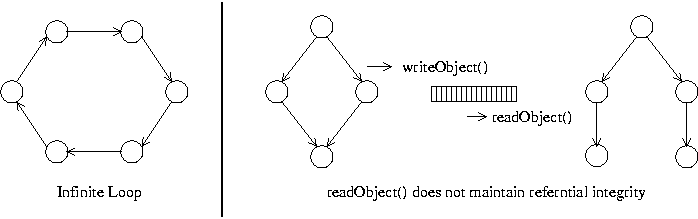
DataSerializable offers improved performance over standard Java serialization, but
does not offer all of the features of standard Java serialization. In particular, data
serialization does not attempt to maintain referential integrity among the objects it is writing
or reading. As a result, data serialization should not be used with complex object graphs.
Attempting to data serialize graphs that contain object cycles will result in infinite recursion
and a StackOverflowError. Attempting to deserialize an object graph that contains
multiple reference paths to the same object will result in multiple copies of the objects that
are referred to through multiple paths.
- Since:
- GemFire 3.5
- See Also:
-
Nested Class Summary
Nested ClassesModifier and TypeInterfaceDescriptionstatic interfaceReplaceableallows an object to write an alternative version of itself to aDataOutput. -
Method Summary
Modifier and TypeMethodDescriptionvoidReads the state of this object as primitive data from the givenDataInput.voidtoData(DataOutput out) Writes the state of this object as primitive data to the givenDataOutput.
-
Method Details
-
toData
Writes the state of this object as primitive data to the givenDataOutput.Since 5.7 it is possible for any method call to the specified
DataOutputto throwGemFireRethrowable. It should not be caught by user code. If it is it must be rethrown.- Parameters:
out- theDataOutputto write to- Throws:
IOException- A problem occurs while writing toout
-
fromData
Reads the state of this object as primitive data from the givenDataInput.- Parameters:
in- theDataInputto read from- Throws:
IOException- A problem occurs while reading frominClassNotFoundException- A class could not be loaded while reading fromin
-